
Functional ingredients: nutrient density as a formulation criterion
Data updated in November 2026.
In the food industry, a functional ingredient is one added to a food for its nutritional contribution: protein, fibre, vitamins, minerals or plant compounds.
The trend reports for 2026 and 2027 agree on one point: consumers increasingly look at what a product delivers relative to what it contains and what it costs. Innova Market Insights has ranked that idea, nutrient density, first among its trends for 2027. At SUPERSENTIALS we grow microgreens on our vertical farm in Alicante and supply them to industry as a functional nutrition ingredient, fresh or freeze-dried.

What the market studies say
Four recent publications help to place demand. None of them is about microgreens; all describe the context in which products are formulated today.
| Source | Date | What it points to |
|---|---|---|
| Innova Market Insights, Top 10 Trends 2027 | October 2026 | Trend no. 1 is "Nutrient Density Design": nutrition culture changes how a product is valued. 59% of consumers worldwide read most or all of the nutrition information on the pack. Next come protein chosen for its quality (36% look for it), sustained energy (39%) and strength with age (35%). |
| Mintel, 2026 Global Food & Drink Predictions | October 2025 | Protein and fibre become mainstream products in 2026. Towards 2030, Mintel forecasts a shift from "maximising" a single nutrient to more varied diets, with blends of seeds, herbs and spices. |
| Innova Market Insights, Top 10 Trends 2026 | November 2025 | Digestive health and protein head the list. Plant-based moves from imitating animal products to delivering its own nutrition. |
| AZTI, Radar EATrends 2026 | February 2026 | "Nutrition with purpose" is the main area of innovation. Consumers reconcile health and sustainability with price, and ask for products that are simple, affordable and credible. |
For an R&D team, the practical reading is easy to state and hard to execute: deliver more per gram, with ingredients the consumer recognises on the list.
Spain: price, own-label products and the label
The Spanish market adds a clear constraint, price. According to the food consumption report of the Ministry of Agriculture, Fisheries and Food, food prices rose by 3% in 2025 and own-label products now account for 48.6% of products bought, 1.4 points more than the year before. Households shop more often and in tighter quantities.
The label matters, even if it is little read. In the Spanish Nutrition Foundation (Fundación Española de la Nutrición) study of 4,640 people, seven out of ten say they do not habitually read labels, and 47.5% ask for the percentage of the main ingredients to be shown more clearly.
A functional ingredient has to justify its cost with a contribution that can be measured and declared, and appear on the list under a name that people understand: broccoli, radish, pea.
Less quantity, more nutrients
The use of GLP-1 drugs for weight management changes what people eat. Those who take them eat smaller portions, and manufacturers look to concentrate more nutrition into less product. FoodNavigator notes that these formulations, originally designed for this group, may spread to other consumers. AZTI lists "GLP-1 friendly" among the most discussed topics on social media in 2025.
An ingredient that delivers vitamins in a few grams fits formats of this kind: small portions, snacks, drinks, sachets.
Local sourcing and short cycles
AZTI describes climate risk as an operational constraint for industry, not a distant scenario. Companies are diversifying suppliers and origins, and local or regional produce is seen as more reliable when supply chains are uncertain.
Microgreens are harvested between 7 and 14 days after germination, according to the USDA Agricultural Research Service. That short cycle makes it possible to plan production by calendar and adjust it to the plant's consumption. We grow on our vertical farm in Alicante, on substrate, without pesticides or synthetic fertilisers.
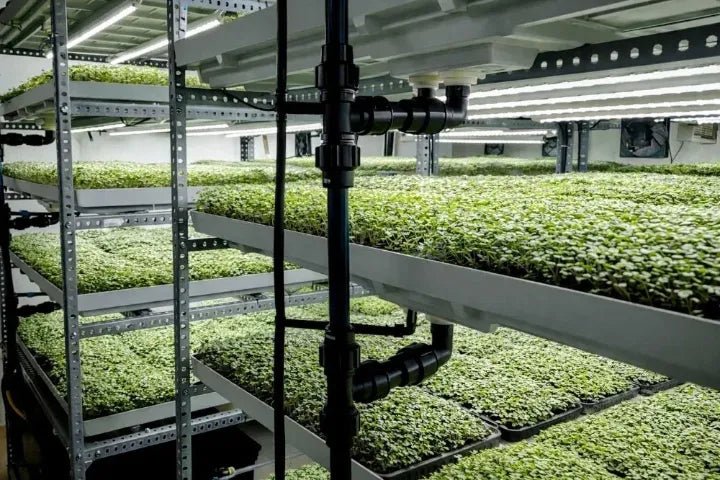
Microgreens as a high-nutrient-density ingredient
Microgreens are young vegetable and herb plants, harvested when the cotyledons, the plant's first leaves, have developed. They are not sprouts: sprouts are grown in water for about two days and eaten with the root.
In 2012, a team from the University of Maryland and the USDA analysed 25 commercial varieties of microgreens (Xiao et al., Journal of Agricultural and Food Chemistry). They measured vitamin C, carotenoids, vitamin K and vitamin E. In general, concentrations were about five times higher than the reference values for mature leaves of the same plant. Vitamin C ranged from 20 to 147 mg per 100 g of fresh weight depending on the species.
The same study shows its limits: differences between species are large, and growing, harvesting and handling conditions affect the final content. That is why each project starts from the chosen variety, not from an average figure.
We freeze-dry with the same process we use for SYNERGIC, our microgreens food supplement, and we run analyses at an external laboratory depending on the project and its nutritional objective.
Brassicas (broccoli, kale, red cabbage, radish) also contain glucosinolates, such as broccoli's glucoraphanin, the precursor of sulforaphane and the subject of numerous studies.
Varieties we grow:
- Brassicas: broccoli, kale, red cabbage, purple radish and others
- Others: wheatgrass, pea, sunflower, basil
All varieties are available fresh or freeze-dried.
Applications by category
The format depends on the process. Fresh adds texture and colour in products without heat treatment; freeze-dried fits into dry blends and long-life products.
| Category | Format | What it delivers | Points to watch |
|---|---|---|---|
| Drinks, juices and smoothies | Fresh (pressed) or freeze-dried | Declarable vegetable content, green colour of plant origin | Strong brassica flavour; powder settling |
| Ready meals, salads and sandwiches | Fresh | Texture, colour, fresh vegetable on the ingredient list | Short shelf life and cold chain |
| Sauces, creams and spreads | Fresh or freeze-dried | Plant contribution in an everyday food matrix | Colour and flavour stability depending on pH and treatment |
| Dairy and plant-based alternatives | Freeze-dried | Plant contribution in yoghurts, drinks or desserts | Powder dispersion and flavour acceptance |
| Food supplements | Freeze-dried | Whole freeze-dried microgreens, on their own or in custom blends according to the nutritional objective of the formula. White label on request | Notification and labelling are the brand owner's responsibility |
How we work with industry
We work mainly in two stages: an industrial trial and, if it works, a recurring supply contract with a planned harvest calendar. One-off orders are available on request. Our production follows an HACCP plan, and the technical data sheet for each variety states its shelf life and storage conditions.
-
You tell us about the project: product category, format (fresh or freeze-dried), expected volume and timelines.
-
We propose varieties and send samples for the plant trial.
-
We agree specifications, a delivery calendar and the supply contract.
Frequently asked questions
What is a functional ingredient?
It is an ingredient added to a food for what it delivers: protein, fibre, vitamins, minerals or plant compounds.
What is the difference between a functional food and a functional ingredient?
The ingredient is the raw material the manufacturer uses. The functional food is the finished product that incorporates it and is presented to the consumer for that contribution.
Which functional ingredients are on trend in 2026 and 2027?
Protein, fibre and digestive health head the Innova Market Insights and Mintel reports for 2026. For 2027, Innova puts nutrient density first: how much a product delivers relative to what it contains.
How do microgreens differ from sprouts?
Sprouts are grown in water for about two days and eaten with the root. Microgreens grow for 7 to 14 days and are harvested above the root, once the cotyledons have developed.
Can I write "source of vitamins" on a product with microgreens?
Only if the finished product reaches the thresholds of Regulation (EC) No 1924/2006 for the vitamin in question. It depends on the dose, the process and the shelf life, so the final product has to be analysed.
Do you take small or one-off orders?
We work mainly with industrial trials and recurring supply contracts, with a planned harvest calendar. If your project is one-off, tell us about it and we will see whether it fits.
Do you offer white-label food supplements?
Yes, on request. We can also supply just the ingredient, freeze-dried microgreens, for you to add to your own formula.
Sources
- Innova Market Insights, Top 10 Trends for 2027
- Innova Market Insights, Top Ten Trends 2026
- Mintel, 2026 Food and Drink Predictions
- AZTI, Radar EATrends 2026 (PDF)
- Ministry of Agriculture, Fisheries and Food (Spain), food consumption report 2025
- Fundación Española de la Nutrición, study on the use of labelling (Interempresas)
- FoodNavigator, Can GLP-1 innovation benefit all consumers?
- Xiao et al. 2012, Journal of Agricultural and Food Chemistry (PubMed)
- USDA ARS, Specialty greens pack a nutritional punch
- NPR, Introducing microgreens
SUPERSENTIALS is registered with the Spanish health authorities as an operator for cultivation, distribution and food supplements. RGSEAA no. 26.025553/A.