Microgreens

A concentrated plant-based ingredient.

Cultivated for its nutrient density.

Microgreens are young vegetable shoots harvested just after the development of the cotyledons and the first true leaves.

Young microgreen leaves in the foreground

Nutritional density

The most powerful vegetables
of the world.

At this early growth stage, the plant naturally concentrates a large portion of its micronutrients, phytochemical compounds, and antioxidants. Microgreens are a superfood, a functional food that allows you to boost your nutrient intake in a simple and natural way.

  1. 40×up to 40 times more vitamins and antioxidants than the mature plant, depending on the species
  2. 5varieties of whole microgreens in every dose of SYNERGIC
  3. 0additives, extracts or fillers

Comparison

How are microgreens different?

Sprouted seeds Sprouted seeds
Mature vegetables Mature vegetables
Nutrient density
Vitamins (C, K, E, A)
Antioxidants / Polyphenols
Glucosinolates / Sulforaphane
Bioavailability
Variable
Media
Proteins (quality + assimilation)
Enzymes

Benefits

Benefits of microgreens

Broccoli microgreens
  1. ANTIOXIDANT ACTION

    Helps protect the body against everyday oxidative stress.

    Microgreens provide plant compounds that contribute to normal oxidative balance, helping to neutralize the impact of metabolic and environmental stress.
    • Vitamin C
    • Polyphenols & Flavonoids
    • Glucosinolates
    • Carotenoids
    • Anthocyanins
  2. ENERGY & VITALITY

    Supports normal energy metabolism and helps maintain vitality.

    Microgreens provide vitamins and minerals that contribute to normal energy-yielding processes and cellular function.
    • Vitamin C
    • Iron
    • Magnesium
    • Potassium
    • Glucosinolates
  3. SKIN & MUCOSA

    Contributes to the normal maintenance of skin and mucous membranes.

    Certain plant-based micronutrients participate in the integrity of the skin and mucous membranes, which act as the body's first natural barrier.
    • Vitamin A
    • Vitamin C
    • Zinc
    • Polyphenols
    • Glucosinolates
  4. VISION

    Contributes to the maintenance of normal vision.

    Microgreens contain carotenoids, which are among the micronutrients associated with normal visual function, especially in the context of a balanced plant-based diet.
    • β-carotene (provitamin A)
    • Lutein
    • Zeaxanthin
    • Vitamin A
  5. DIGESTION

    Contributes to digestive comfort and the proper functioning of the digestive system.

    As a complete plant-based food, microgreens provide fiber and plant compounds that support digestive balance as part of a varied diet.
    • Plant fiber
    • Polyphenols
    • Glucosinolates
    • Enzymes

Our blend

Five microgreens, a balanced synergy.

“Los microvegetales de col lombarda, en particular, han atraído la atención por su potencial para ayudar a proteger contra enfermedades crónicas... Los ratones con dietas que incluían microvegetales de col lombarda presentaron niveles más bajos de colesterol "malo" (LDL) que los ratones con dietas basadas en col lombarda madura.”

Read the article

“Los microvegetales han surgido como una fuente prometedora de nutrientes esenciales y compuestos bioactivos. Nuestro estudio demuestra que su densidad nutricional y capacidad antioxidante superan significativamente a las de las hortalizas maduras, posicionándolos como alimentos funcionales superiores para la nutrición moderna.”

Read the article

“Despite their small size, microgreens contain a much higher nutrient density than mature vegetables. Depending on the species, they can have between 4 and 40 times more vitamins or minerals than the same mature plant.”

Read the article

“A pesar de su pequeño tamaño, concentran un gran valor nutricional, ya que a menudo contienen niveles de nutrientes más altos que las verduras más maduras. Esto los convierte en una buena incorporación a cualquier dieta. Son nutritivos e incluso pueden reducir el riesgo de padecer ciertas enfermedades.”

Read the article

“Early research has indicated that microgreens contain up to 40% more phytochemicals (beneficial nutrients and components) than their full-grown counterparts.”

Read the article

Start your routine

A small step. Every day.

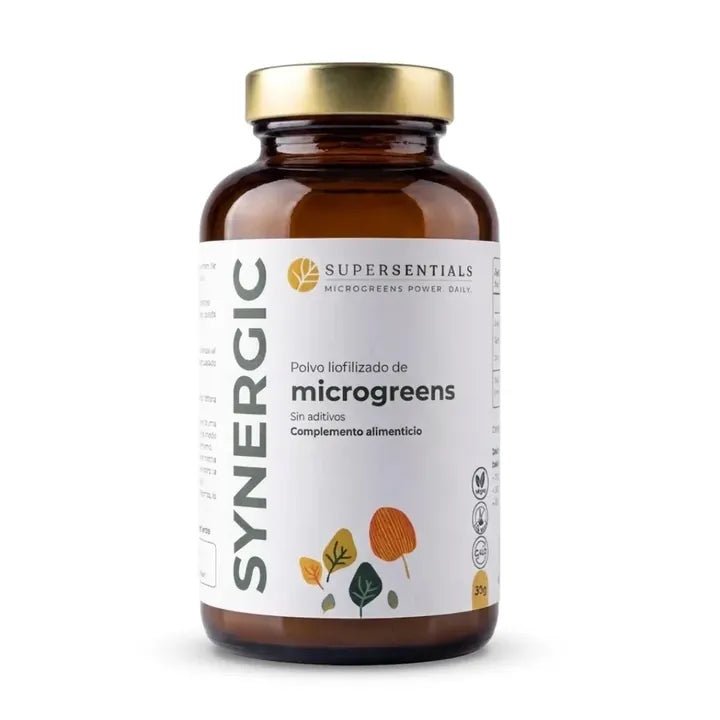
SYNERGIC combines five whole freeze-dried microgreens in a daily dose. At least 10 mg of sulforaphane.

SYNERGIC jar, freeze-dried microgreens powder, 30 g

SYNERGIC

Whole-food Sulforaphane System™

4.98/5.0

Desde $79.20 con suscripción

Any questions?We have answers.

What are microgreens?

They are young plants harvested a few days after germination.

At this stage, they concentrate a high density of protective plant compounds, such as polyphenols, carotenoids and glucosinolates.

That’s why we harvest them at this precise moment and freeze-dry them whole, to preserve their complete plant matrix.

Why is SYNERGIC so nutritious?

Because it is made of whole freeze-dried microgreens.

These young plants stand out for their natural density in nutrients and phytonutrients, such as vitamins, minerals, polyphenols, carotenoids and glucosinolates.

We use no extracts and no additives: we preserve the complete plant matrix, with the natural diversity of compounds that work together within the plant.

Is 1 g per day enough?

It may seem small. But microgreens are naturally highly concentrated in phytonutrients, and freeze-drying removes only the water, not the compounds themselves.

What remains is the whole plant, with its phytonutrient matrix intact, concentrated through freeze-drying.

One gram of SYNERGIC concentrates the equivalent of more than fifteen times its fresh weight.

What does our SYNERGIC microgreens powder taste like?

Mild. Fresh. Light. No bitterness, none of the strong taste other green powders often have.

It goes well in juices, smoothies, water or directly on food. It doesn’t change what you’re having, it simply completes it. We add no flavourings or sweeteners: it is the natural taste of the microgreen, just as it is.

Can anyone take it?

SYNERGIC is designed for adults who want to include sulforaphane in their daily routine.

There are just a few precautions to keep in mind:

It is not recommended for young children, or during pregnancy or breastfeeding.

If you take medication, especially anticoagulants, or have a thyroid condition, consult your healthcare professional before starting.

Any questions about your situation? Write to us, we’ll be happy to guide you.

Why not simply eat broccoli?

Eating broccoli is excellent. But getting enough sulforaphane is not that simple.

Young sprouts contain much more glucoraphanin than mature broccoli. In addition, producing sulforaphane requires myrosinase, a heat-sensitive enzyme that can be inactivated by cooking.

How much broccoli would you need?

To get close to 10 mg of sulforaphane, we estimate you would need about 600 g of raw broccoli or about 4 kg boiled, depending on the variety and preparation.

With SYNERGIC, we concentrate the potential of five whole microgreens in a small daily dose, with a natural sulforaphane-formation system that activates in water.

Keep eating broccoli.
SYNERGIC gives you your daily dose of sulforaphane.

Do you have another question? →